

 Richard Kahn
TL;DR: CAPTCHA and reCAPTCHA help filter bots but are not foolproof. Here's a breakdown:
- Technology and Complexity: CAPTCHA is simpler; reCAPTCHA uses advanced algorithms.
- User Experience: CAPTCHA can be frustrating; reCAPTCHA is smoother.
- Security and Effectiveness: CAPTCHA is less secure; reCAPTCHA offers better protection.
- Data Collection and Privacy: CAPTCHA collects minimal data; reCAPTCHA has privacy concerns.
It’s no secret that bots are a big problem.
According to the latest 2024 data, almost 50% of internet traffic comes from non-human sources. As bots become more advanced, it’s harder than ever before to detect and prevent them.
That’s why many businesses turn to CAPTCHA and reCAPTCHA. These solutions aim to filter out bots, but they are by no means perfect.

CAPTCHA vs reCAPTCHA Examples
Filtering out bots from real traffic is essential to prevent spam, protect user accounts, and secure transactions. This is especially true for performance marketers, who rely on accurate data to make decisions.
Bots generate clicks that don’t represent genuine interest. This results in skewed campaign performance data and wasted ad spend. CAPTCHA and its variations aim to reduce the number of invalid clicks and ensure data integrity.
What is CAPTCHA?
IBM explains that CAPTCHA stands for "completely automated public Turing test to tell computers and humans apart."
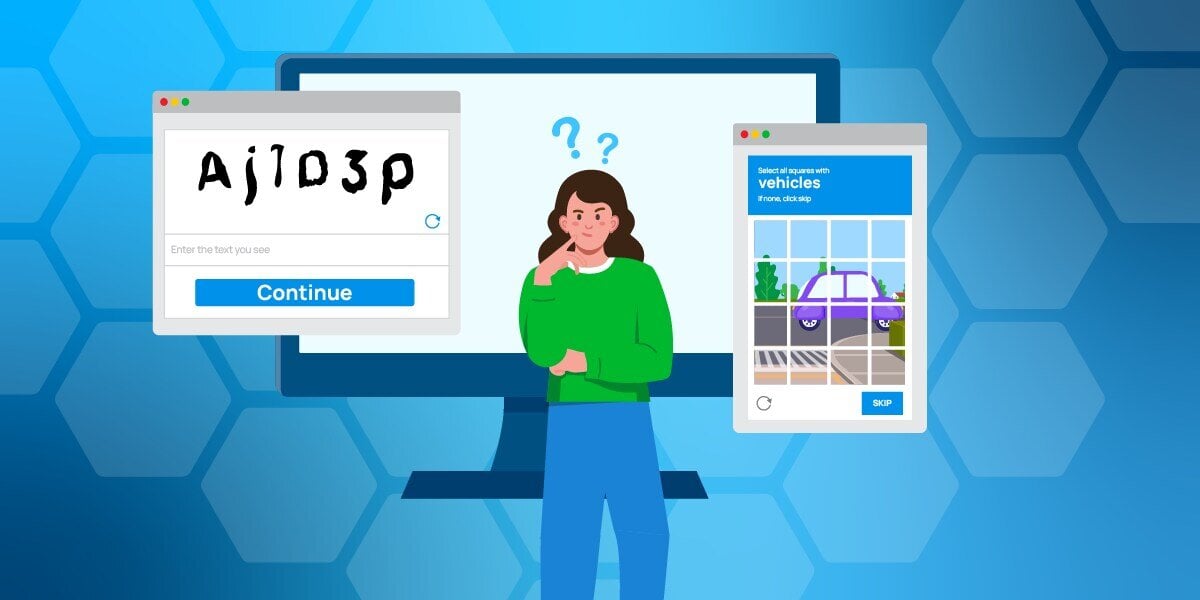
If you’ve ever been online, you’ve likely come across a CAPTCHA. Here’s how the test typically works:
- You'll see a box displaying a series of letters and numbers that are blurred, slanted, or otherwise obscured.
- Below the box will be a text field where you need to type the exact characters you see in the image.
- Once you type them correctly, you'll be granted access to the website or service. Sometimes you will need to submit your entry by clicking a box to confirm you are not a robot.
These distorted characters are designed to be difficult for computer programs to decipher, while still being relatively easy for humans to read. CAPTCHA tests can also be image- or audio-based for accessibility.
What is reCAPTCHA?
reCAPTCHA is a specific CAPTCHA service developed by Google. It’s often considered the standard for CAPTCHA solutions because it’s easy to use and offers a variety of challenges.
There are also a few different versions of reCAPTCHA.
CAPTCHA vs reCAPTCHA v2
This is the most common type of reCAPTCHA since it is easy to integrate into systems. With reCAPTCHA v2, users must tick a box stating they're not a robot. It sometimes involves identifying images.
Invisible CAPTCHA vs reCAPTCHA
Also known as reCAPTCHA v3, it gets its name for running behind the scenes and being “invisible” to the user. It does not require users to solve any challenges and instead monitors user behavior to decipher between humans and bots.
CAPTCHA vs reCAPTCHA vs hCAPTCHA
Let’s throw another CAPTCHA in the mix.
hCAPTCHA is a competing service that primarily uses image labeling challenges to filter bots. This independent service is considered to be more privacy-focused than other options.
reCAPTCHA vs CAPTCHA Key Differences
The main difference between reCAPTCHA and CAPTCHA is that the former is a service from Google while the latter is the general term for any challenge used to differentiate humans from bots.
However, there are some more nuances between the two.
- Technology and Complexity
- CAPTCHA: Is more simplistic and types include text-based, audio, and image challenges.
- reCAPTCHA: Uses more advanced algorithms and offers different versions that are less obtrusive and more accessible.
- User Experience
- CAPTCHA: Potential frustration and accessibility issues, especially for interpreting distorted text.
- reCAPTCHA: Smoother user experience and less intrusive, especially invisible reCAPTCHA.
- Security and Effectiveness
- CAPTCHA: Susceptible to more sophisticated bot attacks.
- reCAPTCHA: Enhanced security measures and bot detection capabilities to protect against more advanced bots.
- Data Collection and Privacy
- CAPTCHA: Minimal data collection, though this depends on the specific CAPTCHA types such as hCAPTCHA.
- reCAPTCHA: Google’s data collection methods have been questioned in terms of privacy. They collect certain user data, which raises some privacy concerns.
CAPTCHA vs reCAPTCHA: Side-by-Side Comparison
Feature |
CAPTCHA |
reCAPTCHA (Google) |
|---|---|---|
|
Definition |
A general security test used to distinguish humans from bots using challenge-response tasks. |
A specific CAPTCHA service developed by Google that combines challenges with behavioral analysis. |
|
What CAPTCHA Stands For |
Completely Automated Public Turing test to tell Computers and Humans Apart. |
Same acronym origin, but implemented as a proprietary Google product. |
|
Technology |
Text-based, image-based, or audio challenges. |
Uses behavioral tracking, risk scoring, image challenges, and invisible monitoring (v2 & v3). |
|
User Interaction |
Requires users to solve a visible puzzle (distorted text, image selection, etc.). |
Can require checkbox/image challenge (v2) or run invisibly in the background (v3). |
|
Bot Detection Method |
Relies on challenge difficulty to block automated scripts. |
Combines challenge-response with behavioral signals and risk scoring. |
|
Security Strength |
Effective against basic bots but vulnerable to AI solvers and human click farms. |
More advanced than traditional CAPTCHA, but still vulnerable to sophisticated automation and score manipulation. |
|
Data Collection |
Minimal, depending on provider (e.g., hCAPTCHA). |
Collects behavioral and browser data through Google infrastructure. |
|
Privacy Considerations |
Typically limited data collecction. |
Raises privacy concerns due to Google tracking and data usage. |
|
User Experience |
Often frustrating and inaccessible for some users. |
Designed to reduce friction, especially with invisible reCAPTCHA. |
|
Effectiveness Against Modern Fraud |
Limited — can be bypassed by AI-driven CAPTCHA bots and human-assisted fraud. |
Better than basic CAPTCHA, but still not sufficient as a standalone fraud prevention solution. |
While reCAPTCHA improves on traditional CAPTCHA technology, both systems rely on challenge-based validation. Modern fraud tactics, including browser automation, AI-based CAPTCHA solvers, and human click farms, can bypass both solutions. This makes CAPTCHA security insufficient for protecting advertising campaigns from invalid traffic and sophisticated bot activity.
CAPTCHA Shortcomings
Why CAPTCHA Is No Longer Enough to Stop Bots
CAPTCHA and reCAPTCHA are often a website’s first line of defense against bots. But in 2026, they are no longer sufficient as standalone fraud prevention tools.
Modern bot operators use artificial intelligence, browser automation, residential proxy networks, and even human click farms to bypass CAPTCHA challenges at scale. What once blocked simple scripts now struggles to stop sophisticated invalid traffic.
1. CAPTCHA Can Be Bypassed by AI-Driven Bots
Advancements in machine learning have made CAPTCHA challenges significantly easier to solve. AI-based image recognition tools can identify traffic lights, storefronts, and objects in reCAPTCHA grids with high accuracy. Text-based CAPTCHA puzzles are even more vulnerable.
As a result, CAPTCHA bots and automated solvers are widely available and effective.
2. reCAPTCHA Risk Scores Can Be Manipulated
Google’s reCAPTCHA v3 assigns a risk score based on user behavior. While this reduces friction, it introduces new vulnerabilities.
Sophisticated bots simulate:
- Mouse movement patterns
- Scroll behavior
- Keystroke timing
- Session navigation
By mimicking legitimate human behavior, automated scripts can receive “low risk” scores and bypass reCAPTCHA without triggering visible challenges.
Risk scoring does not equal fraud detection.
3. Human Click Farms Bypass CAPTCHA Security
Not all CAPTCHA bypass tactics rely on automation.
Click farms employ real people to manually solve CAPTCHA challenges before bots resume automated actions. Because a human completed the challenge, the session appears legitimate, even though the traffic is part of coordinated fraud.
This hybrid model makes CAPTCHA ineffective against large-scale ad fraud and fake lead operations.
4. CAPTCHA Creates User Friction and Accessibility Issues
CAPTCHA challenges add unnecessary friction to the user experience. Visitors may abandon forms, logins, or checkout processes if puzzles are confusing or time-consuming.
Additionally, users with visual impairments, cognitive disabilities, or language barriers often struggle with distorted text or image-based challenges.
Blocking real customers while letting advanced fraud through is a losing equation.
5. CAPTCHA Does Not Provide Fraud Intelligence
Even when CAPTCHA blocks a bot, it does not provide insight into:
- Where the fraudulent traffic originated
- How the bot behaved
- What campaign or channel was targeted
- Whether coordinated fraud is occurring
CAPTCHA only tests a single moment in time. It does not analyze behavior across sessions, devices, or campaigns.
For advertisers and performance marketers, that lack of visibility is a major blind spot.
The Bottom Line: CAPTCHA Is a Speed Bump, Not a Security Strategy
CAPTCHA may reduce basic spam, but it is not designed to stop modern bot networks, sophisticated invalid traffic (SIVT), or human-assisted fraud schemes.
As bot attacks evolve, businesses need more than challenge-response tests. They need real-time fraud detection, environmental analysis, and source-level intelligence to protect ad spend and preserve data accuracy.
CAPTCHA vs Modern Fraud Detection
CAPTCHA and reCAPTCHA rely on challenge-response validation. Modern fraud detection solutions analyze environmental behavior and intent in real time. Here’s how they compare:
CAPTCHA vs Advanced Fraud Detection
Capability |
CAPTCHA / reCAPTCHA |
Advanced Fraud Detection (Anura) |
|---|---|---|
|
Challenge-Based Testing |
Yes |
No |
|
Environment Analysis |
No |
Yes |
|
Detects Human Click Farms |
No |
Yes |
|
Identifies Fraud Source |
No |
Yes |
|
User Friction |
High (sometimes invisible but still restrictive) |
None |
|
Real-Time Fraud Intelligence |
No |
Yes |
Stop Ad Fraud with Anura
To protect your campaign from bots, you need a comprehensive fraud solution. Anura goes beyond traditional bot detection methods, providing enhanced security to effectively identify and mitigate fraudulent activities from bots and human click farms.
Anura effectively stops ad fraud to ensure bots are blocked and your business does not lose out on real opportunities. Stop wasting money on traffic that will not convert, learn more about Anura today.