


 Anura PR Team
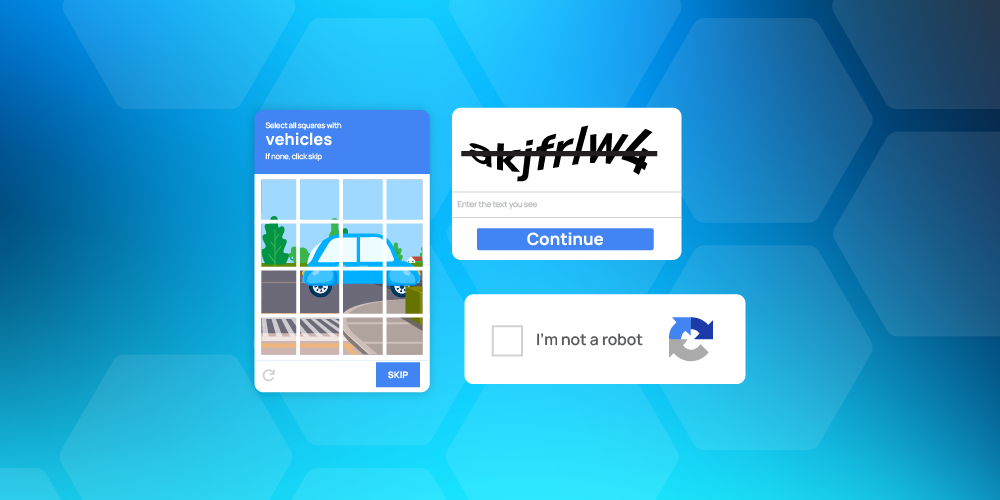
CAPTCHA meaning: CAPTCHA stands for Completely Automated Public Turing test to tell Computers and Humans Apart.
A CAPTCHA is a security test used to determine whether a user is human or a bot by requiring them to complete a simple challenge, such as selecting images or typing distorted text. While originally effective, modern bots and fraud tactics can now bypass CAPTCHA systems with ease.
TL;DR
- A CAPTCHA is a security test used to determine whether a user is human or a bot
- CAPTCHA challenges include tasks like image selection, puzzles, or typing distorted text
- Modern bots can bypass CAPTCHA using AI, automation tools, and human-assisted click farms
- CAPTCHA is no longer effective as a standalone bot prevention method in 2026
- It often blocks real users while allowing sophisticated fraud to pass undetected
- Modern bot detection relies on real-time analysis of the full traffic environment, not one-time challenges
CAPTCHA was designed to be the digital gatekeeper. But in today’s fraud landscape, that gate is wide open.
Whether it’s identifying squiggly letters, clicking images of traffic lights, or simply checking a box, CAPTCHA challenges try to distinguish humans from bots. But they’ve become more of a speed bump for real users than a roadblock for fraudsters. Here's why.

What is a CAPTCHA Test?
A CAPTCHA test (sometimes known as a CAPTCHA challenge) is a test used to confirm whether a user is human by requiring them to complete a task, such as selecting images, solving puzzles, or typing distorted text. The distorted text is sometimes called a “CAPTCHA code.”
CAPTCHA tests are designed to deter automated programs, including bots trying to create fake accounts, post spam, scrape data, or guess passwords.In the past, these CAPTCHA challenges were tests a bot or AI agent could not complete. The assumption was that humans could recognize distorted characters while optical character recognition software could not. As a result, such tests could prove that the user was human. That’s why many CAPTCHA tests simply require a user to check a box confirming they are not a robot. However, that box isn’t taking your answer on faith. It’s actually tracking the surrounding behavior and risk signals.
Why did CAPTCHA tests change? As image recognition improved, bots became increasingly good at solving distorted text. CAPTCHA designers responded by making the images harder. The issue was that making the tests harder made them harder for humans, too. In some cases, fraudsters even routed their CAPTCHA codes to inexpensive human-solving services as a CAPTCHA bypass. These are sometimes known as “click farms.” Now that bots and automated systems are getting smarter and more advanced, modern fraud techniques can frequently bypass them.
How Does CAPTCHA Work?
Modern CAPTCHA works a bit differently now compared to the CAPTCHA tests of the past. Early CAPTCHAs were simple. They usually displayed distorted letters or numbers and asked you to type them into a box. Behind the scenes, each website generated a random CAPTCHA code (usually a random string of letters and/or numbers). Then, it rendered that answer as an image with warped text, overlapping lines, noise, or unusual backgrounds. The correct answer was stored securely on the server, often in a temporary session. When you submitted your response, the server compared it with the stored answer. Only a correct response allowed the requested action to continue.
However, as bots became better at recognizing distorted text, CAPTCHA tests had to change to keep up. Instead of relying on a CAPTCHA code, modern systems may evaluate signals such as:
- Mouse movements and interaction patterns
- How quickly a form is completed
- Browser and device information
- Previous activity associated with the connection
- Whether the request resembles known automated traffic
Many newer CAPTCHA systems run mostly in the background and assign the interaction a risk score. If the system determines you’re a low-risk visitor, you’ll be able to proceed. If the test flags you as suspicious, you may be routed to complete a more traditional CAPTCHA puzzle or other human intelligence task. Bots are only getting smarter, however. Today, CAPTCHA is flawed and comes with serious accessibility and privacy concerns.
Why CAPTCHA Is No Longer Effective (and How It's Bypassed)
CAPTCHA was originally designed to stop basic bots, but modern fraud techniques have made it easy to bypass.
Today’s attackers use a combination of:
- AI models trained to solve image and text challenges
- Browser automation tools that simulate real user sessions
- Residential proxy networks that rotate IP addresses
- Human-assisted fraud, such as click farms solving challenges manually
Because of these techniques, CAPTCHA is no longer a reliable standalone defense. It often blocks legitimate users while allowing sophisticated fraud to pass through undetected.
CAPTCHA vs Bot Detection: What's the Difference?
CAPTCHA |
Bot Detection |
|---|---|
|
Challenge-based |
Real-time analysis |
|
Interrupts users |
Invisible to users |
|
Easily bypassed |
Hard to evade |
|
No attribution |
Source-level insights |
|
One-time test |
Continuous detection |
CAPTCHA and modern bot detection solve the same problem in very different ways.
CAPTCHA focuses on testing a single interaction, while modern bot detection analyzes the full traffic environment to identify fraud accurately.
Are there any CAPTCHA alternatives that work?
Yes — and you don’t have to choose between user experience and fraud prevention.
Anura analyzes every visitor in real time, detecting bots, human fraud, malware, and spoofing with 99.999% accuracy when identifying visitors as bad while using Anura Script. No friction. No guesswork. No legitimate visitor blocked.
Instead of relying on challenges that can be gamed, Anura uses advanced detection to uncover:
- Device spoofing
- Browser automation
- Repetitive click patterns
- Form submission anomalies
- Behavioral red flags
You don’t just stop bots — you understand them.
Why are CAPTCHAs still used?
Many websites still use CAPTCHAs because they’re easy to install and free. But that convenience comes at a cost. When bots get through and real visitors get blocked, it damages your conversions, data quality, and brand trust.
More importantly, relying on CAPTCHA alone gives a false sense of security. Fraud isn’t stopped by puzzles. It’s stopped by visibility — and that’s where Anura leads the industry.
“CAPTCHAs have outlived their usefulness as a primary fraud prevention tool. Modern fraud needs modern solutions.” – Anura’s Fraud Prevention Team
How Anura does it better
Anura’s ad fraud detection solution doesn’t rely on outdated CAPTCHA tests or visitor assumptions. Instead, we analyze every interaction across your digital ecosystem, providing clear, actionable insights into who’s real — and who’s not.
Other tools guess. We guarantee. That’s the power of our Accuracy Guarantee.
Want a better way to keep out bad bots?
Fraudsters aren’t slowing down. Don’t let outdated tools like CAPTCHA stand between you and real performance. Experience what true fraud prevention feels like.
Start with a Traffic Quality Audit.