

 Anura PR Team

TL;DR: Your conversion rate measures how effectively your marketing turns interest into action — and when it’s low, it signals missed opportunities and wasted spend. This blog explores the top three reasons your conversion rate may be underperforming and how to fix them.
Readers will discover:
- Misaligned audience targeting: Ads may not be reaching or resonating with the right people.
- Poor user experience: Confusing layouts, long forms, or slow pages can kill conversions.
- Ad fraud: Fake clicks and form fills from bots waste budget and skew campaign data.
- Optimization insights: How to evaluate campaign data and align ad messaging with landing pages.
- The fix: Partnering with an ad fraud detection solution can help reclaim wasted spend and improve true conversion performance.
Advertising has always faced one fundamental question: “How do we know it’s working?”
Before digital advertising, the simple answer was to look at sales results: if they were up, the campaign was working, without any further proof or consideration of other factors; if sales were down, the ads simply weren’t working.
Digital campaigns, however, offer a more measurable approach. Marketers now focus on conversion rates to determine success.
When creating campaigns, marketers begin with the end in mind. In other words, they determine whether the goal of the campaign is to grow the company’s email marketing list, drive visitors to a landing page, generate leads, or complete a sale on an e-commerce site.
A campaign’s conversion rate reflects its performance. For instance, if 15 out of 100 visitors to a lead-generation page complete and submit a form, the conversion rate is 15%. Not all of those leads will become customers, but a campaign can still be deemed successful if it meets its conversion goals, even without an immediate sales spike.
So, if conversions don’t directly translate into sales, why does a low conversion rate matter? What can it tell us about campaign performance, and how can you improve it?
Let’s dive in.
What are Conversion Rates?
A conversion rate measures how effectively a campaign turns audience interest into action. It’s the percentage of users who complete a desired goal out of the total number of visitors who interacted with your ad or website.
This metric is one of the most important indicators of campaign performance because it reveals how well your marketing efforts drive meaningful results
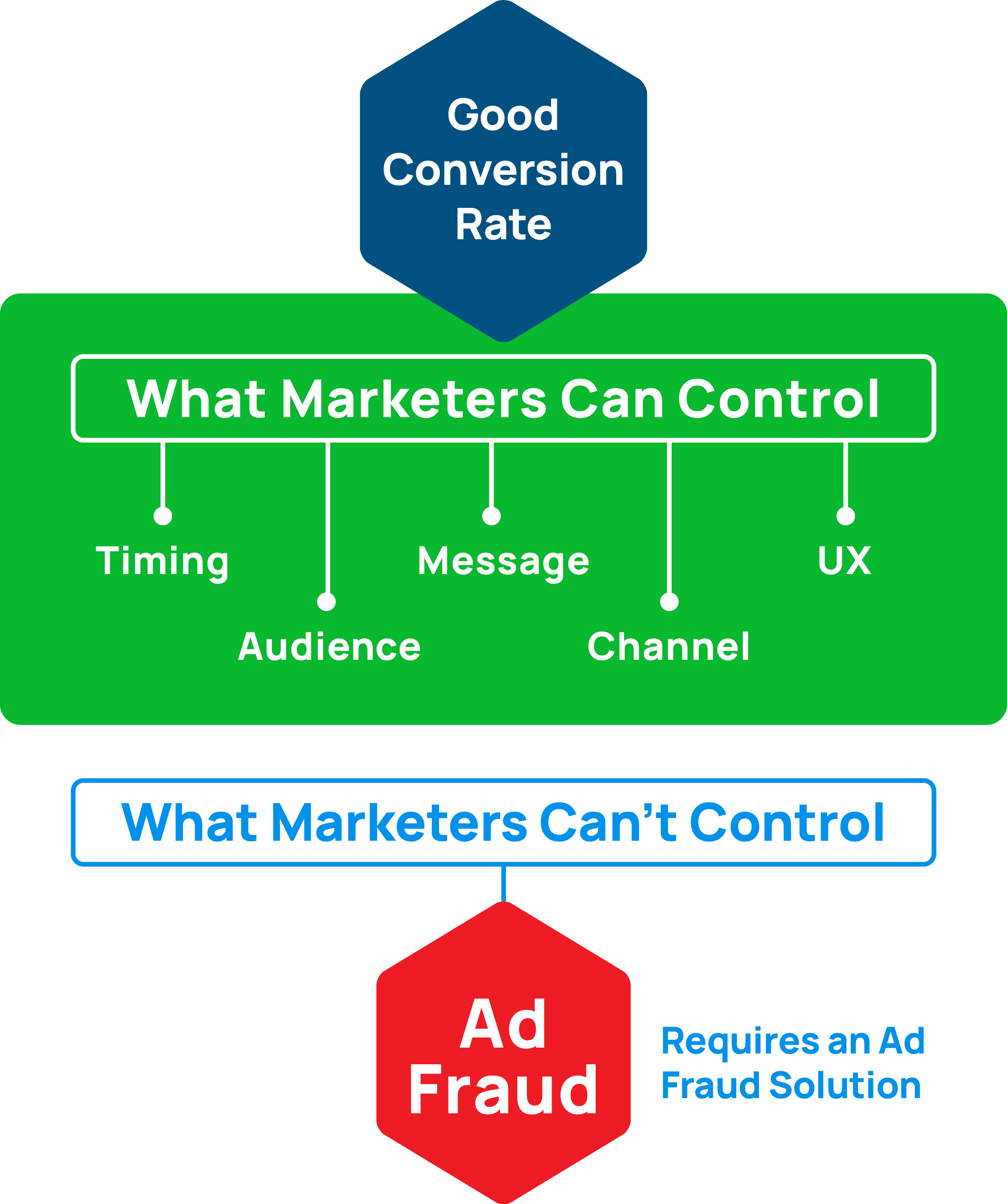
A high conversion rate indicates a digital marketing campaign is targeting the right audience at the right place and time with the right message delivered through the right channels. A low conversion rate lets marketers know that the campaign is somehow missing the mark and wasting ad dollars. If campaign data indicates poor performance, marketers have the opportunity, if not an obligation, to pull the plug and re-evaluate.
When Clicks Don’t Equal Conversions
As we said before, clicks don’t always equal conversions.
A “high click-through rate but low conversion” pattern is more common than many marketers realize. While more people may be engaging with your ads, that doesn’t always translate into meaningful actions.
A high click-through rate, low conversion scenario can be a red flag. It means people are interested enough to click your ad but aren’t compelled to take the next step. This disconnect can point to:
- A mismatch between your ad message and the landing page content.
- Poor user experience or long forms that discourage completion.
- Misaligned targeting bringing in the wrong audience.
There are a few reasons a campaign may not hit the mark, and it will likely take some digging to determine which one or more factors are causing your campaign to underperform.
Why Are My Conversion Rates Lower Than Expected?
Before you can improve your conversion rate, you need to discover why your campaign is underperforming in the first place.
Looking at some of the most common reasons, you may avoid ditching the entire campaign; a few simple tweaks may salvage the time and effort already invested and set you up to increase your conversion rate.
1. Not Targeting the Right Audience
Remember, conversion is all about the right message to the right audience at the right time through the right channel or platform. There’s no guarantee that this will happen every time, but there are things you can do to improve to increase conversion.
To get the right audience, look at your best existing customers: age, gender, geographic location, etc. For B2B, look at job titles and industries.
Does your message and creative appeal to this audience to make them want to learn more? Are they ready to buy?
Are your ads running where your target audience will see them? If you’re placing display ads programmatically, they may be appearing on sites that your audience isn’t visiting, or they may be running on made-for-advertising (MFA) sites or sites known for spreading misinformation.
2. Confusing User Experience
You might be targeting the right audience, but are you making it easy for them to convert? A poor user experience frequently leads to poor campaign performance. Some things to look at from a user perspective include:
Does the search or display ad link work? Broken links can’t convert.
Does the website or landing page load quickly on any device? Users’ time is valuable; if your website has slow load times, they may abandon it.
Is the landing page consistent with your website and brand? Users want to know they are on a legitimate site they can trust with their personal information. They will look for key items like your logo.
Is the call to action clear? Are users finding what the ad they clicked on promised? Maybe you’re asking for more information than you need or that the prospect is willing to provide. If you see anything that may be confusing or complicated, clean it up and make sure you are asking visitors to take only one action.
Are you inadvertently preventing them from converting? Is there a pop-up blocking the page? These “extras'' create clutter and confusion; they’re the equivalent of a cluttered, disorganized store or that pesky salesperson that appears out of nowhere the second you stop to look at the merchandise.
3. You’re a Victim of Ad Fraud
This presents unique challenges in identifying and addressing the issue. At first, it may appear that your campaign is converting as well as (or even better than) expected and at a rapid rate, but then you get a lot of “unsubscribes” or undeliverable emails. The contact information from your lead generation campaign is invalid, or your sales reps reach angry and confused people who aren’t expecting your call, or they are not interested in buying your products.
When this happens, you’re likely looking at ad fraud. Bots and human fraud farms can generate a lot of clicks and quickly fill out contact forms. This enables them to collect revenue while your campaign falls flat.
Addressing issues with the target audience and campaign elements can usually be handled internally or with the help of your marketing agency. Addressing fake traffic and ad fraud requires expert help, which only an ad fraud solution can provide.
Learn how Anura helped QuinStreet increase conversions without increasing marketing spend.
How An Ad Fraud Partner Can Help Improve Your Conversion Rate
Even the most well-optimized campaigns can fall flat if fake traffic is skewing your data and draining your budget. That’s why an ad fraud detection partner should be a core part of your conversion rate optimization strategy.
The right ad fraud partner can help improve your conversion rates by identifying the source(s) of fake traffic that won’t convert and then taking proactive measures to stop fake traffic from clicking on your ads and completing your contact or lead generation forms.
This also helps you save money and improve your marketing ROI, since you won’t have to pay out for fraudulent conversions, and you can direct your resources toward channels that drive actual results.
Imagine what your campaigns could achieve if even a fraction of that wasted budget went toward reaching real customers.
Let us show you how much fraud you have today, where it’s coming from, and how you can increase conversion without increasing your marketing budget!